
Variables
Description
What is this formula?
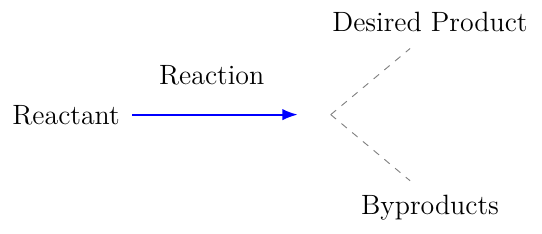
Selectivity measures how preferentially a reaction forms the desired product relative to undesired byproducts.
When to use it
Use this formula when evaluating reaction performance, catalyst effectiveness, process optimization, and competing reaction pathways.
Example
Given:
Desired product formed = 4.5 mol
Byproducts formed = 0.5 mol
Formula:
S = ndesired / nbyproducts
Substitution:
S = 4.5 / 0.5
Result:
S = 9
The reaction produces nine moles of desired product for every mole of byproducts formed.
Applications
Organic synthesis
Catalysis
Petrochemical processing
Reaction engineering
Industrial chemistry
Note
Several definitions of selectivity exist in the chemical engineering and organic chemistry literature. This version expresses selectivity as the ratio of desired product formed to undesired byproducts formed and is one of the most common definitions for comparing reaction performance.
Some authors define selectivity relative to reactant consumption or as a percentage. When comparing values from different sources, the exact definition should always be verified.