
Variables
Description
What is this formula?
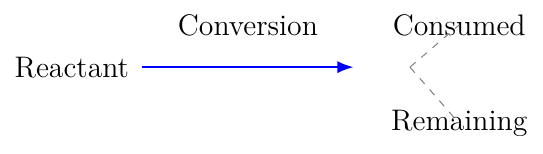
Percent conversion measures the fraction of a reactant that has been transformed into products during a chemical reaction.
When to use it
Use this formula to evaluate reaction progress, compare reaction conditions, optimize reactors, and monitor chemical processes.
Example
Given:
Initial reactant amount = 5.0 mol
Unreacted reactant amount = 1.2 mol
Formula:
X = ((n0 - n)/n0) × 100
Substitution:
X = ((5.0 - 1.2)/5.0) × 100
Result:
X = 76%
Seventy-six percent of the reactant has been converted into products.
Applications
Organic synthesis
Reaction engineering
Catalysis
Polymer chemistry
Industrial process optimization
Note
Conversion measures how much reactant disappears, not how much desired product is formed. A reaction can exhibit high conversion while still producing significant amounts of undesired byproducts. For this reason, conversion is often analyzed together with yield and selectivity.