
Variables
Description
What is this formula?
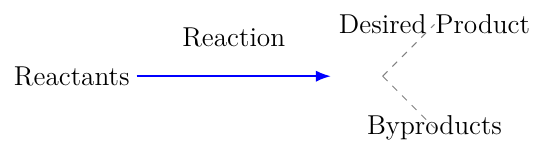
Atom economy measures the fraction of reactant atoms that become part of the desired product. It is a key metric in green chemistry because it evaluates the theoretical efficiency of a reaction independently of experimental yield.
When to use it
Use this formula when comparing synthetic routes, evaluating reaction sustainability, or selecting processes that minimize waste generation.
Example
Reaction:
C2H4 + H2O → C2H5OH
Desired product:
Ethanol
MWdesired = 46.07 g/mol
Total product molar mass = 46.07 g/mol
Formula:
AE = (MWdesired / MWtotal) × 100
Substitution:
AE = (46.07 / 46.07) × 100
Result:
AE = 100%
All atoms from the reactants are incorporated into the desired product.
Applications
Green chemistry
Process development
Industrial organic synthesis
Sustainable manufacturing
Chemical process evaluation
Note
Atom economy is a theoretical metric based solely on the balanced chemical equation. Unlike reaction yield, it does not consider incomplete conversion, side reactions, purification losses, or operational inefficiencies. A process may have high atom economy but low reaction yield, or vice versa. Both metrics should be evaluated together when assessing reaction performance.