
\[m_{th}=n_{lim}\frac{\nu_{prod}}{\nu_{lim}}MW_{prod}\]
Variables
mththeoretical product mass (g)
nlimmoles of limiting reactant (mol)
vprodstoichiometric coefficient of product
vlimstoichiometric coefficient of limiting reactant
MWprodmolar mass of product (g/mol)
Description
What is this formula?
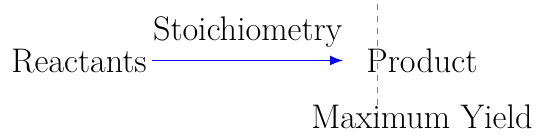
The theoretical yield is the maximum amount of product that can be formed from a given quantity of limiting reactant according to the balanced chemical equation.
When to use it
Use this formula before performing a reaction to estimate the maximum obtainable product, evaluate process efficiency, or compare actual and expected production.
Example
Reaction:
2 H2 + O2 → 2 H2O
Given:
Limiting reactant H2 = 5.0 mol
Stoichiometric coefficient of H2 = 2
Stoichiometric coefficient of H2O = 2
Molar mass of H2O = 18.015 g/mol
Formula:
mth = nlim × (νprod/νlim) × MWprod
Substitution:
mth = 5.0 × (2/2) × 18.015
Result:
mth = 90.1 g
Maximum theoretical water production is 90.1 g.
Applications
Chemical manufacturing
Laboratory synthesis
Reaction design
Process optimization
Chemical engineering