
Variables
Description
What is this formula?
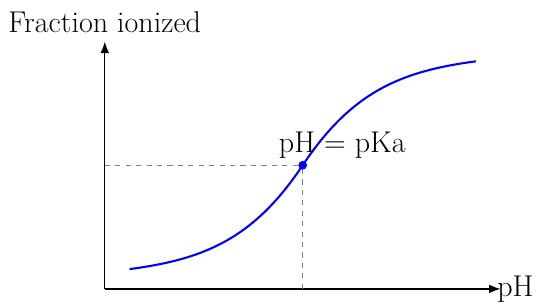
The Henderson–Hasselbalch equation relates the pH of a buffer solution to the acid dissociation constant (pKa) and the ratio of conjugate base concentration to weak acid concentration.
When to use it
Use this equation to estimate the pH of buffer solutions, determine the required acid-to-base ratio for a target pH, or analyze acid–base equilibria involving weak acids.
Example
Given:
pKa = 4.76
[A−] = 0.20 mol/L
[HA] = 0.10 mol/L
Formula:
pH = pKa + log([A−]/[HA])
Substitution:
pH = 4.76 + log(0.20/0.10)
pH = 4.76 + log(2)
pH = 4.76 + 0.301
Result:
pH = 5.06
Applications
Buffer preparation
Analytical chemistry
Biochemistry
Pharmaceutical formulations
Environmental chemistry
Note
This equation is an approximation derived from the acid dissociation equilibrium expression. It is most accurate for dilute buffer solutions where activity coefficients are close to unity. At high ionic strengths or very concentrated solutions, activity corrections may be required.