
Variables
Description
What is this formula?
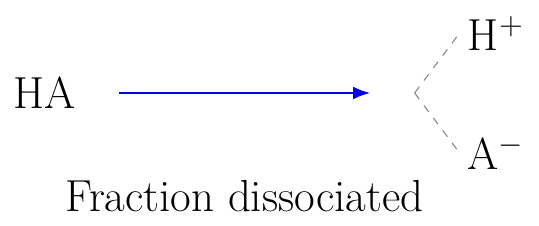
The degree of dissociation represents the fraction of a substance that dissociates into ions or smaller species at equilibrium.
When to use it
Use this formula when studying weak acids, weak bases, electrolytes, and chemical equilibrium systems where only part of the original substance dissociates.
Example
Given:
Initial amount of acetic acid = 0.100 mol
Amount dissociated = 0.0042 mol
Formula:
α = nd / n0
Substitution:
α = 0.0042 / 0.100
Result:
α = 0.042
The acid is 4.2% dissociated.
Applications
Weak acid analysis
Weak base analysis
Electrolyte chemistry
Equilibrium calculations
Physical chemistry
Chemical education
Note
The degree of dissociation is a dimensionless quantity ranging from 0 to 1. In practice, it depends on concentration, temperature, ionic strength, and the nature of the solute. Strong electrolytes typically have values close to 1, while weak acids and weak bases often have much smaller values.
Some textbooks express the result as a percentage by multiplying α by 100. In fCalc, the primary result is stored as a fraction to maintain consistency with equilibrium calculations.