
Variables
Description
What is this formula?
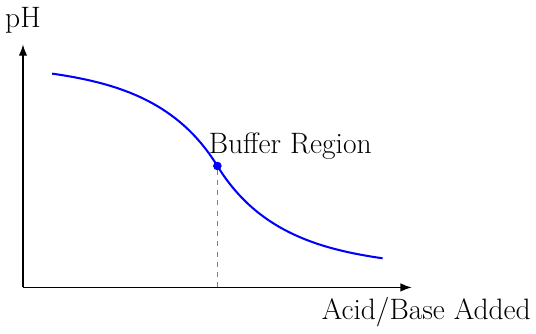
Buffer capacity quantifies the ability of a buffer solution to resist changes in pH when acid or base is added.
When to use it
Use this formula when evaluating the effectiveness of buffer systems, comparing different buffer formulations, or determining how much acid or base can be added before a significant pH change occurs.
Example
Given:
Added NaOH = 0.020 mol/L
Observed pH change = 0.50
Formula:
β = Δn / ΔpH
Substitution:
β = 0.020 / 0.50
Result:
β = 0.040 mol·L⁻¹·pH⁻¹
Applications
Buffer design
Pharmaceutical formulations
Biochemistry
Analytical chemistry
Environmental monitoring
Industrial process control
Note
The rigorous thermodynamic definition of buffer capacity is β = dn/d(pH), which is a differential expression. Because fCalc only supports explicit algebraic formulas, this implementation uses the experimentally measured finite-difference approximation β = Δn/ΔpH.
For small pH changes, the approximation closely matches the differential definition and is widely used in laboratory practice. The result represents the amount of strong acid or strong base that must be added per liter to change the pH by one unit. More advanced theoretical treatments may include activity corrections and full equilibrium calculations.