
Variables
Description
What is this formula?
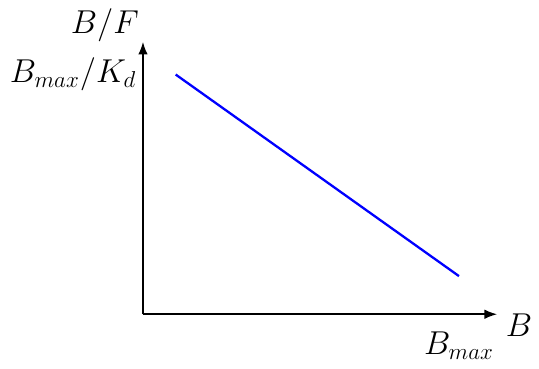
The Scatchard binding relation is used to analyze ligand binding data by relating the bound-to-free ligand ratio to the amount of ligand bound.
For a single class of independent binding sites, the Scatchard plot is linear. The slope is related to the dissociation constant, and the x-intercept represents the maximum binding capacity.
When to use it
Use this formula when analyzing receptor-ligand binding, protein-ligand interactions, radioligand assays, and equilibrium binding experiments.
Example
A binding system has:
Bmax = 100 nmol/L
B = 40 nmol/L
Kd = 20 nmol/L
Formula:
BF = (Bmax − B)/Kd
Substitution:
BF = (100 − 40)/20
BF = 3
Result:
Bound-to-free ligand ratio = 3
Applications
- Protein-ligand binding studies
- Receptor pharmacology
- Radioligand binding assays
- Biochemistry
- Molecular biology
- Drug discovery
- Binding capacity analysis
Note
The Scatchard relation is a linearized binding model. It assumes equilibrium binding, one class of independent binding sites, and no cooperativity. Real biological systems may show curved Scatchard plots due to multiple binding sites, cooperative effects, nonspecific binding, or experimental error.