
Variables
Description
What is this formula?
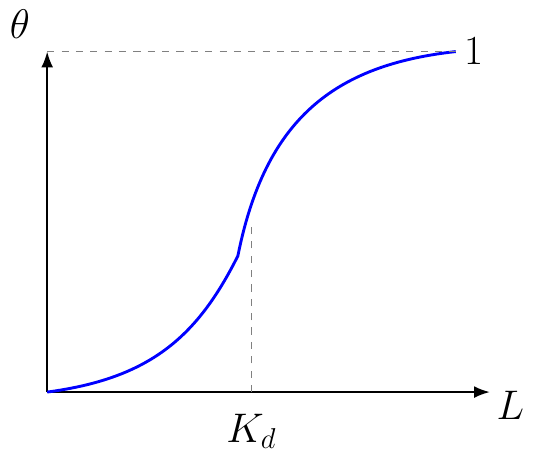
The Hill binding equation describes cooperative ligand binding to receptors or proteins.
Unlike the Langmuir model, it accounts for situations where binding of one ligand molecule affects the binding of additional ligand molecules.
The Hill coefficient quantifies cooperativity.
n = 1 indicates independent binding.
n > 1 indicates positive cooperativity.
n < 1 indicates negative cooperativity.
When to use it
Use this equation when studying receptor binding, cooperative proteins, hemoglobin oxygen binding, pharmacology, and cell signaling.
Example
A receptor has:
Kd = 10 nM
n = 2
L = 20 nM
Formula:
θ = L^n/(Kd^n + L^n)
Substitution:
θ = 20²/(10² + 20²)
θ = 400/(100 + 400)
θ = 0.80
Result:
Fractional occupancy = 0.80
80% of binding sites are occupied.
Applications
- Receptor pharmacology
- Protein-ligand interactions
- Hemoglobin oxygen binding
- Cooperative binding analysis
- Drug discovery
- Molecular biology
- Cell signaling
Note
The Hill equation is an empirical model that summarizes cooperative binding behavior. The Hill coefficient does not necessarily correspond to the actual number of binding sites. More detailed mechanistic models may be required to describe complex binding systems.