
Variables
Description
What is this formula?
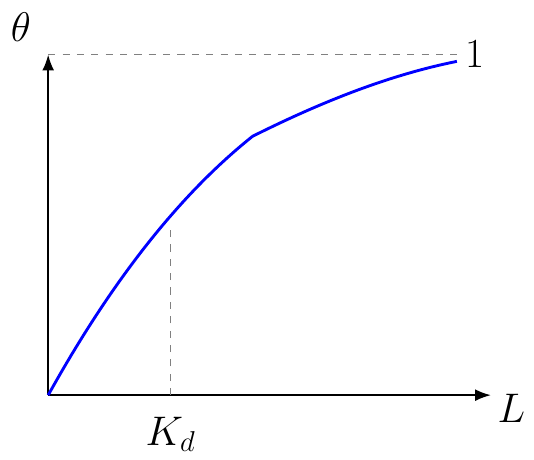
Fractional occupancy describes the fraction of receptor or binding sites occupied by a ligand at equilibrium.
The value ranges from 0 to 1:
θ = 0 indicates no occupied sites.
θ = 1 indicates complete occupancy.
When L = Kd, occupancy reaches 50%.
Kd represents the ligand concentration required to occupy half of the available binding sites.
When to use it
Use this formula when studying receptor-ligand interactions, protein binding, pharmacology, molecular biology, and biochemical binding systems.
Example
A receptor has:
Kd = 5 nM
L = 15 nM
Formula:
θ = L/(Kd + L)
Substitution:
θ = 15/(5 + 15)
θ = 0.75
Result:
75% of binding sites are occupied.
Applications
- Receptor pharmacology
- Protein-ligand interactions
- Drug discovery
- Molecular biology
- Biochemistry
- Binding assays
- Cell signaling
Note
This model assumes a single class of independent binding sites and equilibrium conditions. It does not account for cooperative binding, allosteric effects, or multiple receptor populations. For cooperative systems, the Hill binding equation is often more appropriate.
Also known as:
- Langmuir Binding Isotherm
- Langmuir Adsorption Model (binding form)
- Single-Site Binding Model