
Variables
Description
What is this formula?
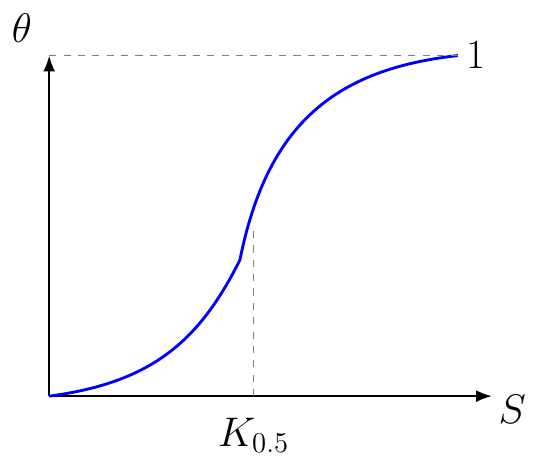
The Hill equation describes cooperative binding behavior in enzymes, receptors, and other biological macromolecules.
Unlike the Michaelis–Menten model, the Hill equation can represent situations where the binding of one substrate molecule influences the binding of additional molecules.
The Hill coefficient (n) quantifies the degree of cooperativity.
n = 1 indicates no cooperativity.
n > 1 indicates positive cooperativity.
n < 1 indicates negative cooperativity.
When to use it
Use this equation when studying cooperative enzymes, allosteric proteins, receptor-ligand interactions, oxygen binding to hemoglobin, and biological signaling systems.
Example
An enzyme has:
K0.5 = 5 mmol/L
n = 2
S = 10 mmol/L
Formula:
θ = S^n/(K0.5^n + S^n)
Substitution:
θ = 10²/(5² + 10²)
θ = 100/(25 + 100)
θ = 0.80
Result:
Fractional saturation = 0.80
The enzyme is 80% saturated.
Applications
- Enzyme kinetics
- Allosteric regulation
- Receptor pharmacology
- Hemoglobin oxygen binding
- Signal transduction
- Molecular biology
- Systems biology
Note
The Hill equation is an empirical model that summarizes cooperative behavior but does not describe the underlying molecular mechanism. The Hill coefficient should not always be interpreted as the exact number of binding sites. More detailed mechanistic models may be required for complex biological systems.