
Variables
Description
What is this formula?
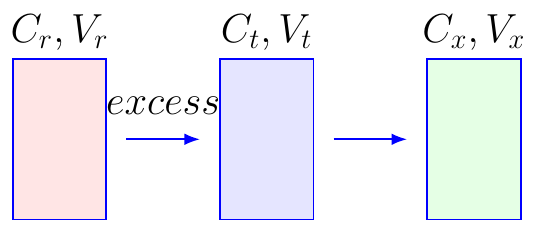
Back titration concentration calculates the concentration of an analyte by adding a known excess of reagent and then titrating the unreacted excess with a second titrant.
It is useful when direct titration is slow, incomplete, unstable, or difficult to observe.
When to use it
Use this formula when the analyte reacts slowly with the titrant, when the endpoint is difficult to detect directly, or when the sample is insoluble but can react with a known excess reagent.
Example
A sample reacts with 50.0 mL of 0.100 mol/L reagent added in excess. The remaining excess reagent is titrated with 12.0 mL of 0.0500 mol/L back titrant. The original sample volume is 25.0 mL.
Data:
Cr = 0.100 mol/L
Vr = 50.0 mL
Ct = 0.0500 mol/L
Vt = 12.0 mL
Vx = 25.0 mL
Formula:
Cx = (CrVr − CtVt)/Vx
Substitution:
Cx = (0.100×50.0 − 0.0500×12.0)/25.0
Cx = (5.00 − 0.600)/25.0
Result:
Cx = 0.176 mol/L
The analyte concentration is 0.176 mol/L.
Applications
- Determination of carbonate content
- Analysis of insoluble samples
- Pharmaceutical assays
- Food chemistry
- Environmental analysis
- Industrial quality control
Note
This simplified form assumes a 1:1 stoichiometric relationship between the analyte, excess reagent, and back titrant. For reactions with different stoichiometric coefficients, the equivalent amounts must be corrected using the balanced chemical equation.