
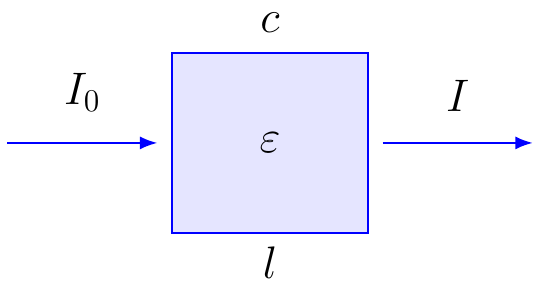
Variables
Description
What is this formula?
The absorptivity coefficient, also called the molar absorptivity or molar extinction coefficient, quantifies how strongly a chemical species absorbs light at a specific wavelength.
It is obtained by rearranging the Beer-Lambert Law and is an intrinsic property of a substance under specified experimental conditions.
When to use it
Use this formula when determining the optical properties of a compound, developing analytical methods, comparing chromophores, or characterizing substances using spectrophotometry.
Example
A solution produces:
A = 0.750
using:
l = 1.00 cm
c = 5.00×10⁻⁵ mol/L
Formula:
ε = A/(lc)
Substitution:
ε = 0.750/(1.00×5.00×10⁻⁵)
Result:
ε = 15000 L·mol⁻¹·cm⁻¹
The molar absorptivity coefficient is 15000 L·mol⁻¹·cm⁻¹.
Applications
- UV-Visible spectroscopy
- Compound identification
- Analytical method development
- Pharmaceutical analysis
- Environmental chemistry
- Biochemical measurements
Note
The absorptivity coefficient depends on wavelength, solvent, temperature, and chemical form of the analyte. Therefore, published values should only be used under conditions similar to those under which they were measured.