
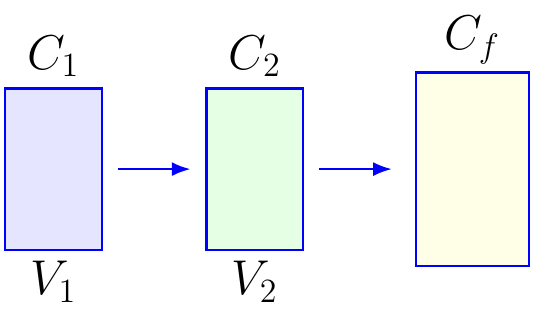
Variables
Description
What is this formula?
The mixing concentration formula calculates the final concentration obtained when two solutions containing the same solute are mixed together. The result is a volume-weighted average concentration.
When to use it
Use this formula when combining solutions of different concentrations, preparing laboratory reagents, blending industrial products, or calculating the composition of mixed streams.
Example
A chemist mixes:
Solution 1:
C1 = 2.0 mol/L
V1 = 1.0 L
Solution 2:
C2 = 5.0 mol/L
V2 = 3.0 L
Formula:
Cf = (C1V1 + C2V2)/(V1 + V2)
Substitution:
Cf = (2.0×1.0 + 5.0×3.0)/(1.0 + 3.0)
Cf = (2 + 15)/4
Cf = 17/4
Result:
Cf = 4.25 mol/L
The final concentration of the mixture is 4.25 mol/L.
Applications
- Solution preparation
- Chemical blending
- Water treatment
- Pharmaceutical manufacturing
- Industrial process control
- Analytical chemistry
Note
This formula assumes that volumes are additive and that no chemical reaction occurs during mixing. For highly concentrated solutions, non-ideal mixtures, or systems with significant volume contraction or expansion, more advanced models may be required.