
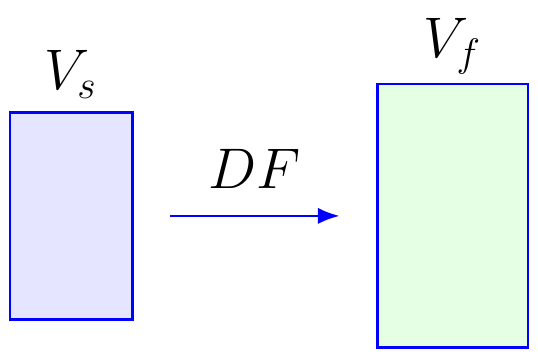
Variables
Description
What is this formula?
The dilution factor expresses how many times a sample has been diluted. It is defined as the ratio between the final volume and the original sample volume used to prepare the diluted solution.
When to use it
Use this formula when preparing laboratory dilutions, microbiological samples, analytical standards, environmental samples, and pharmaceutical solutions.
Example
A technician transfers 10 mL of a stock solution into a volumetric flask and adds solvent until the final volume reaches 100 mL.
Data:
Vs = 10 mL
Vf = 100 mL
Formula:
DF = Vf/Vs
Substitution:
DF = 100/10
Result:
DF = 10
The solution was diluted by a factor of 10.
Applications
- Laboratory solution preparation
- Microbiology
- Analytical chemistry
- Pharmaceutical testing
- Environmental analysis
- Calibration standard preparation
Note
The dilution factor is dimensionless and indicates only the degree of dilution. For a simple dilution, it is numerically equal to the ratio of the initial concentration to the final concentration.