
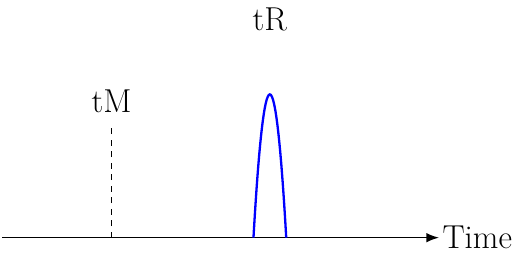
Variables
Description
What is this formula?
The capacity factor measures how strongly an analyte is retained by the stationary phase relative to the mobile phase.
It is one of the most important chromatographic parameters because it describes retention independently of column length and flow rate.
When to use it
Use this formula when developing chromatographic methods, comparing columns, evaluating retention behavior, and optimizing separations.
Example
Given:
tR = 8.5 min
tM = 2.0 min
Formula:
k' = (tR - tM)/tM
Substitution:
k' = (8.5 - 2.0)/2.0
Result:
k' = 3.25
The analyte spends approximately 3.25 times more time interacting with the stationary phase than moving with the mobile phase.
Applications
HPLC
Gas chromatography
Method development
Column evaluation
Analytical chemistry
Note
The capacity factor is one of the fundamental parameters of chromatography.
General interpretation:
k' < 1 → insufficient retention
1 ≤ k' ≤ 10 → desirable retention range
k' > 10 → excessive retention and long analysis time
Most chromatographic methods are optimized to obtain k' values within a practical operating range that balances separation quality and analysis speed.